We make your AI implementation deliver to your P&L.
3nayan helps organisations build business proficiency and resilience — linking strategy, transformation, and technology to measurable performance outcomes.

Strategy today cannot be separated from technology, data, and AI. 3nayan helps organisations define implementable strategies that align vision, capability, and measurement — and then execute against them.
We run readiness diagnostics, build AI roadmaps, and create maturity pathways so that every strategic decision is grounded in performance data and organisational reality.

Most transformations stall from misalignment between strategy, execution, and measurement — rarely from lack of vision. 3nayan brings these together under a single coherent structure.
Our work covers business re-imagination, capability building, process orchestration, and change enablement — from design through to scaled delivery.

Sustainable performance requires that investments in people, process, and technology work together rather than independently. 3nayan uses its proprietary MIDAS model to strengthen the systems that enable this.
Typical interventions include process re-engineering, micro-organisation design, automation readiness, and capability diagnostics — each tied to measurable improvement targets.

Growth depends on an organisation's ability to sense change, redeploy assets, and act with precision. 3nayan helps enterprises re-energise strategy, optimise operations, and realign investment to sustain competitive performance.
Our engagements combine structural and behavioural interventions — from customer centricity and data culture to analytics-backed diagnostics that link strategic direction to business outcomes.
3nayan enables enterprise transformation by aligning leadership ambition with measurable business outcomes. We architect strategic redirection, operating model redesign, and capability renewal — integrating strategy, organisation, and technology into a unified performance system.

Whether the mandate is enterprise strategy, digital transformation, or AI-led performance, our approach embeds analysis, design, and delivery into a single accountable architecture. Every intervention is outcome-driven, financially disciplined, and built for sustained impact — with clear metrics, readiness assessments, and capability tracking.
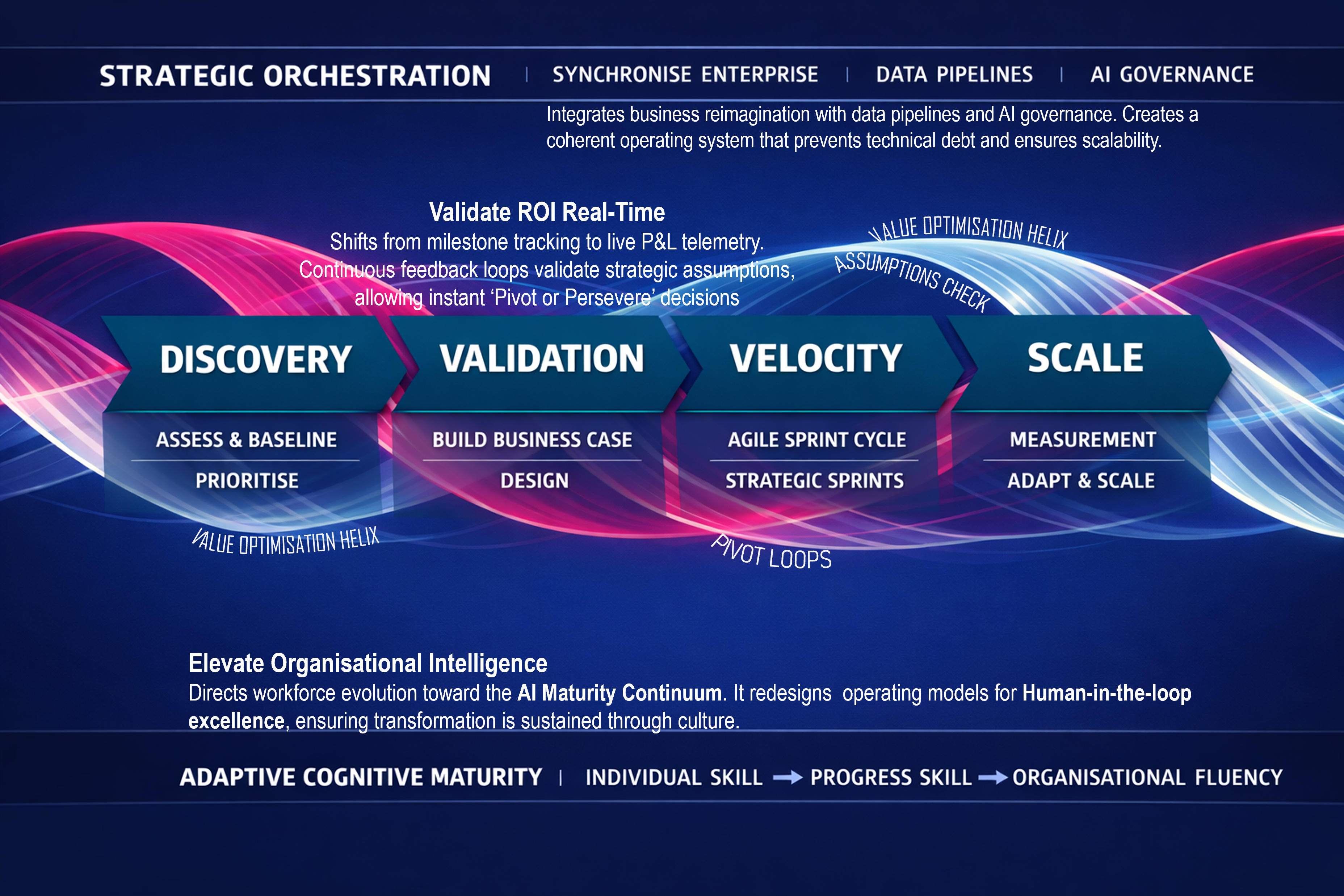
To operationalise this, we deploy proprietary execution frameworks. The Navigator Framework provides the method, tools, and governance to align programmes with enterprise goals and track value realisation across the transformation lifecycle.
Transformation Delivery Engine
Every 3nayan engagement operates within this architecture. From strategy conception through to scaled delivery, NAVIGATOR ensures each intervention is outcome-driven, financially disciplined, and built for sustained impact.
AI Impact & Momentum
Most organisations are investing in AI. Few are translating that into measurable business impact. The gap between AI spend and P&L outcomes is not a technology problem — it is a measurement, governance, and maturity problem.
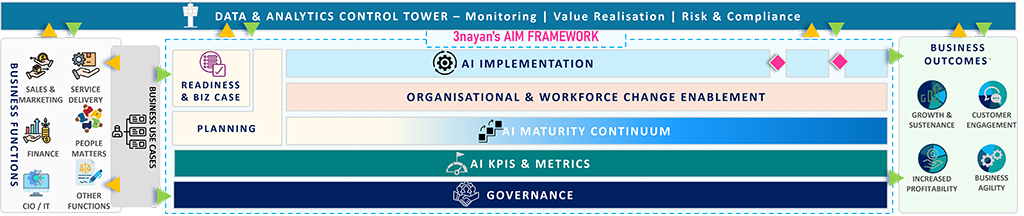
AIM is 3nayan's integrated strategic system designed to close that gap.
Built across four interconnected components, AIM gives CXOs a disciplined structure to manage AI performance end-to-end:
AIM connects readiness, execution, measurement, and maturity into a single performance architecture for AI.


Business processes were manual and unstandardised, lacking customer-centricity. IT infrastructure couldn't scale. Automation potential in claims and policy administration remained untapped. Organisation competed in a crowded market without digital foundations.
Mapped and reimagined all business processes through a digital transformation lens. Built enterprise-wide digital strategy with phased roadmap, enterprise architecture, and four AI/RPA automation use cases. Established governance across regulators, investors, employees, and partners.
Investor valuation of $1Bn directly attributed to the DX roadmap. Standard Operating Procedures implemented across operations for the first time. Automation pilots reduced process turnaround times significantly. Organisation positioned as digital-first competitor.
Multi-node global operations running unsynchronised. Onshore-offshore delivery methodology fragmented, project management inconsistent. Customer satisfaction declining; key accounts at risk of churn.
Reworked delivery methodology and project management framework end-to-end. Redesigned operating model with clear onshore-offshore interaction protocols. Rebuilt software engineering practices, release management, and capability-building with full change management.
Cycle time for customised configurations significantly reduced. Scope leakage and bug leakage per release cut dramatically. Customer satisfaction restored and retention improved, enabling renewed growth.
Public company with 6X revenue growth target faced critical IT bottleneck. Infrastructure grown organically with no blueprint. IT unable to scale; no data strategy. Required robust foundation before embarking on SCM 2.0 digital transformation.
Designed 2-speed IT architecture strategy spanning enterprise apps (CRM, SAP, WMS, TMS), edge computing, and IoT. Defined short, medium, and long-term implementation roadmaps with project schedules, governance models, and vendor restructuring.
Clear, accepted implementable IT direction established. Infrastructure positioned to support SCM 2.0 and 6X revenue scaling. Vendor relationships restructured for efficiency. Organisation capability lifted for digital transformation.
Operations fragmented across 6 nodes. 258 processes unstandardised, metrics inconsistent. Resource pyramid unclear; cost-per-head not transparent. Employee experience fragmented across transport, facilities, and cafeteria. No single version of truth.
Executed 60-day Lean Six Sigma blitz across four workstreams: Process (258 processes mapped), People (employee experience), Metrics (400 parameters standardised, 20 analytics dashboards), and Optimisation (seating, resource management, supply-demand tools).
$2Mn in realised savings. Service and capability portfolio defined across all 6 nodes. Standardised metrics and dashboards enabled control-tower-driven operations. Data culture initiated; positive employee experience created.
Delivery leadership lacked visibility into resource pyramid structures and cost-per-hour dynamics. Grade-level distribution impact on profitability was opaque. No mechanism to model what-if scenarios for hiring, attrition, or inflation.
Built R-based analytics and visualisation tool depicting pyramid structures and cost-per-hour by business unit. Enabled real-time what-if scenario modelling across hiring, attrition, and compensation changes streamed from source systems.
$5Mn annual cost avoidance identified. Leaders gained dynamic visibility into pyramid impact on cost-per-hour. Data-driven workforce planning enabled. Cost control mechanisms now embedded across the organisation.
Company with 6X revenue ambition embarking on its first analytics journey. MIS rudimentary; data quality poor. Warehouse staff using data as basic job aids only. No coherent analytics roadmap aligned to SCM 2.0 or growth targets.
Developed elaborate analytics strategy with multi-phase roadmap and architecture maps per phase. Provided technology, implementation, and vendor recommendations. Built workforce upskilling roadmap, data quality remediation plan, and initiated POCs with vendors.
Organisation positioned to become data-run. Control-tower-driven operations initiated with real-time visibility. Intelligent collaboration through data-informed decision-making enabled across the supply chain.
Back-office Finance & Accounting running at high cost across multiple EU countries. Brexit posed talent shortage and continuity risk. Silo'ed operations across geographies prevented economies of scale; cost structure unsustainable.
Designed Bucharest F&A hub as centralisation strategy. Modelled resource disengagement vs. hiring needs. Built detailed phased transition plans, ROI analysis, Brexit contingency scenarios, knowledge transfer protocols, and implementable schedules.
Immediate and ongoing cost savings realised through consolidation. Brexit operational risks mitigated. EU economies of scale achieved. Phased transition executed with zero service disruption. Cost structure now competitive.
Brexit threatened imminent high-skill resource shortage in a critical domain. Existing resourcing model vulnerable; no viable talent pipeline. Operational failure risk unacceptable for an essential public service.
Mapped all operational areas by location and skill requirement. Orchestrated workforce re-deployment across geographies. Built scenario-based resourcing strategy with multiple implementation pathways and detailed transition roadmaps with rapid execution capability.
Government gained strategic readiness and optionality before Brexit impact. Viable talent pipeline created across geographies. Operations protected through forward-looking workforce planning. Ministry equipped with multiple scenario plans for evolving political conditions.
Most analytics investments underdeliver — not because of technology, but because of poor preparation across data management, quality, integration, and delivery discipline. This white paper draws on 3nayan's field experience to map the four critical foundations that separate analytics programmes that generate 200–1000% ROI from those that stall after the first dashboard.
India's health insurance sector is at an inflection point — driven by AI, cloud, wearables, telehealth, and blockchain — yet only 10% of insurers use digital tools to manage claims. This paper examines the technology landscape, the tangible benefits already emerging for early movers, and the regulatory, cultural, and legacy integration barriers preventing the sector from realising its full transformation potential.
The Middle East is adopting health insurance technology faster than most markets — driven by capital availability and strong government ambition. This paper surveys live deployments across the region — AI, blockchain, wearables, telemedicine, VR — and maps the imminent shifts in payment models, preventive care focus, and AI-driven customer experience redesign.
Fee-for-service is structurally misaligned with patient outcomes. This paper examines five emerging payment models — value-based payment, pay-for-performance, shared savings, bundled episodes, and capitation — analysing their benefits, global case studies, and the multi-stakeholder leadership required to accelerate their adoption in India.
Quick commerce is projected to hit ₹843bn by 2029 at 24.84% CAGR. This paper examines the macro drivers, competitive dynamics between Blinkit, Zepto, Swiggy Instamart and the looming entry of Amazon, Flipkart, and Reliance, investment considerations, operational challenges, and broader societal impact across metro and Tier 2/3 cities.
Large language models are moving beyond text generation into operational intelligence — with significant implications for supply chain management. This presentation explores how LLMs can enhance demand forecasting, supplier communication, logistics optimisation, and knowledge management across the supply chain.
Watch Presentation ↗Our blog covers AI strategy, enterprise transformation, and the evolving role of technology in business performance. Perspectives drawn from real engagements, not theoretical models.
Read 3nayan Insights ↗3nayan (tri.na.yan) — the third eye — represents the strategic perception required to navigate enterprise complexity.
We bring the intellectual rigour and execution power of a Tier 1 consulting firm, delivered with the agility and accountability that only a focused advisory practice can offer — at a differentiated price point.
Our engagements are built on three convictions:
We extend our reach through a curated network of specialist associates, ensuring the right expertise at the right cost for every mandate.
Would you like to know more about how we could help your organisation? We would love to have a conversation.
#50 RBI Colony, Anandnagar,
Bangalore — 560024, India.