The AI Empathy Premium: Navigating Human-Centric Service Transitions
While the IT services sector reeling from market corrections, the shockwaves are inching toward a more intimate frontier: Human-Centric Services. From retail banks to healthcare front-desks, the panic will set in shortly. If AI can simulate rapport and handle complex queries, what happens to the millions of “service” roles?
The market might not have fully priced this in yet, but the “Claude Moment” for service industries is imminent. Most organizations are still in the “denial” phase; treating AI as just another chatbot. But neither denial, nor “admiring the problem” will save a retail footprint or a branch network.
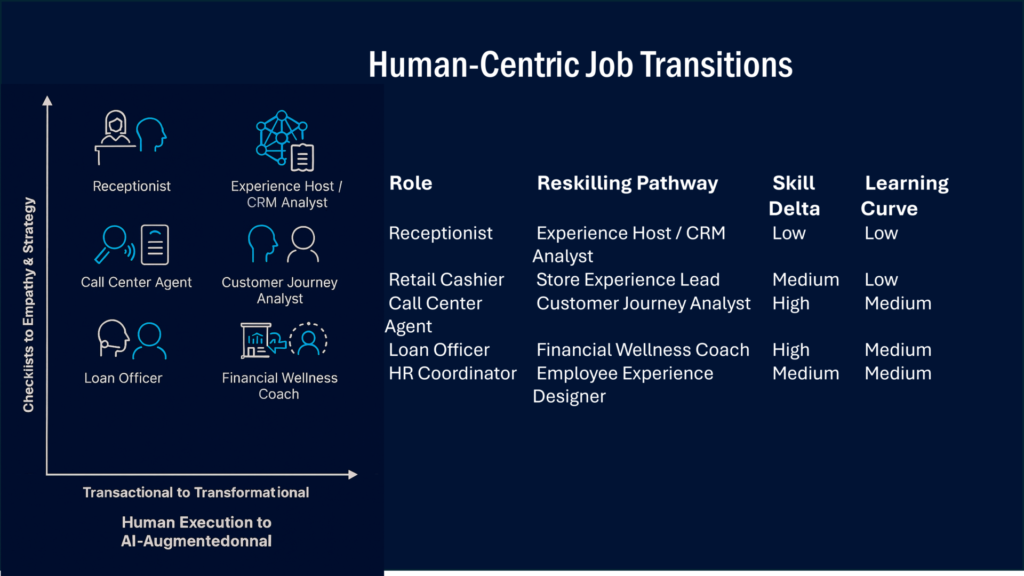
The Human-Centric Service transitions are not about replacing people with screens; they are about re-engineering roles to capture genuine judgment and high-stakes trust. These are premia that AI cannot simulate.
The Blueprint for Service Evolution
Our 40 Futures, part of 3nayan’s AIM (AI Implementation and Momentum) framework identifies that for service roles, the Skill Delta is actually an gap in Emotional Intelligence. The intent is to move from transactional execution to transformational experiences. Let us consider three examples of such transitions.
1. Retail Cashiers to Experience Hosts: The “checkout” is a legacy bottleneck; if your staff is just scanning barcodes, they are pointlessly competing with a machine.
- The Insight: The role moves from processing sales to curating brand logic. The human becomes the circuit-breaker for exceptions that automated systems treat as binary errors. You aren’t scanning items; you are scanning human sentiment to prevent brand churn and anchor customer loyalty.
2. Loan Officers to Financial Wellness Coaches / Risk Orchestrator: AI now owns the approval data, calculating credit scores and debt-to-income ratios faster than any human.
- The Insight: The “approval” is now a commodity. The new value is in coaching through experience quagmires that, process and humans created. Anything from life transitions, health crises, entrepreneurial risks or sudden change in regulations. You become a trust-broker who uses AI data to design a financial future, rather than just mindlessly auditing a financial past.
3. Front-Desk Receptionists to Experience Analysts: The traditional gatekeeper is being replaced by orchestrated agents that handle scheduling and basic queries with 99% accuracy.
- The Insight: AI cannot yet perform a “vibe check.” The new role holds the integrity of the experience. You intervene when the automated system fails to recognize the urgency in a client’s demeanor or the distress in a patient’s voice. You are the guardian of the “Human Interface.”
Managing the Human Momentum
The Human-Centric Service transitions prove that just being there, is no longer a metric of success. Leaders must focus on level of trust, or its maturity, rather than headcount. Three things that must happen, with AI:
- Clarity: Define exactly where the automated agent ends and the human expert begins, of what causes that control to pass.
- Control: Implement empathy-governance to ensure AI doesn’t dehumanize the customer journey.
- Confidence: Track how quickly your front-line staff is maturing from managing a transaction to creating an experience.”
The market correction is a starter’s pistol for every industry that touches a customer. The future isn’t about “self-service” kiosks that frustrate your users. It must be about a high-touch, high-value transition where AI handles the script so humans can handle the soul. The question for CEOs in retail, banking, hospitality or healthcare: Are you training your staff to compete with a machine, or to manage it?
Next in this series: We move from the storefront to the control room, analyzing the transition in Systems Oversight.
If you want the specific reskilling tables for the Human-Centric sector, drop “40 Futures” in the comments.
#AI #HumanCentric #FutureOfWork #40Futures #3nayan #ExperienceEconomy #Reskilling #RetailInnovation
About The Author
