The IT Services Crash: Engineering a Structural Way Out
The stock market has delivered a blow to the traditional billable-hour model. Accenture (ACN) is trading below $225, down from a high of $285 (not in the distant past). As you may discern, this isn’t just a market fluctuation or a simple correction, but a fundamental repricing of the $250-billion tech industry. We all know, the IT services crash was immediate response to the “Claude Moment” driven by Anthropic’s agentic AI announcements. AI can now autonomously handle tasks that once required thousands of junior billable hours.
For companies and professionals, the era of “admiring the problem” (still on, on social media forums) must end. The IT Services crash is the starter’s pistol for a transition from labor-intensive outsourcing to high-value orchestration.
The Blueprint for the IT Services Transition
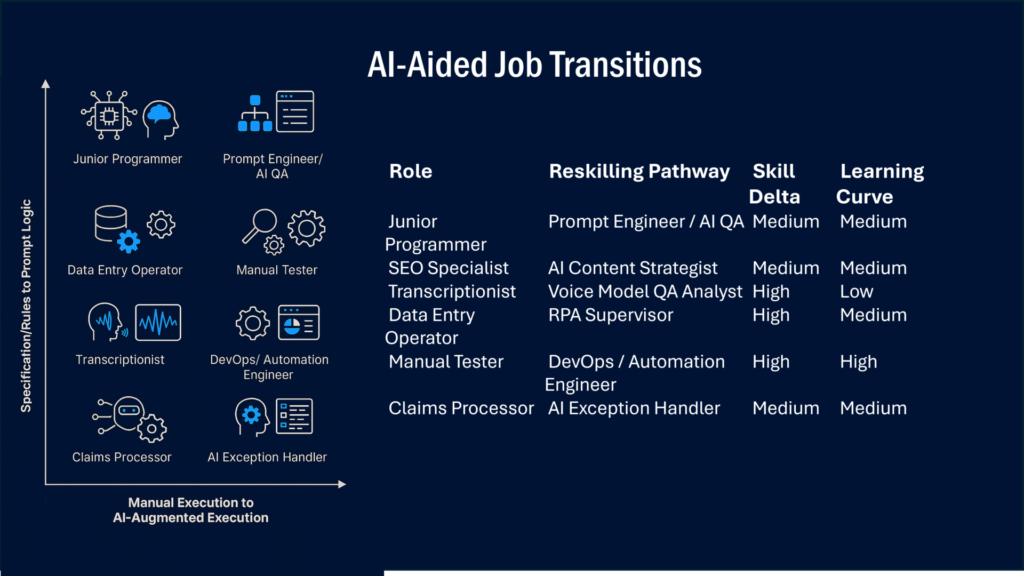
Our 40 Futures framework identifies the specific reskilling pathways to navigate this IT services crash. The goal is to move from routine execution to roles that command a higher human premium. Below are some examples.
1. Junior Programmers to Prompt Engineers / AI QA : Roles focused on writing boilerplate code are the epicentre of the risk. This is all programmers with five-six years of experience of less. Claude can now generate and document code with minimal human intervention.
- The Pathway: Transition to Prompt Engineering or AI Quality Assurance.
- The Insight: Not just about “using a tool”, the vanilla coders will get wiped out too. For anyone with less than six years of experience, the value has shifted from writing code to editing intent. In a 3rd-order sense, the programmer is becoming a “Logic Auditor.” Your worth is no longer measured by how fast you type / code and debug, but by your ability to spot a logical hallucination in a thousand lines of AI-generated code that looks alright, but fails at the edge cases.
2. Manual Testers to DevOps / Automation Engineers: Repetitive sanity and regression testing will be the first casualties of agentic AI automation.
- The Pathway: Reskill into DevOps and Automation Engineering.
- The Insight: The “click-and-verify” roles are moribund. The 2nd-order consequence here is the total integration of QA/QC and Infra. A Tester who doesn’t understand the self-healing CI/CD pipeline won’t cut it anymore. The transition isn’t just to automation, but to system resilience. You are now building the immunity backbone of the application, not just looking for symptoms of a malaise.
Let us look at one more.
3. Data Digitization to Data Curation & Annotation: Bulk processing of forms, or identity documents, or transcription are now highly commoditized by high-accuracy AI.
- The Pathway: Transition to Data Curation & Annotation Specialists.
- The Insight: Bulk processing of forms is commodity. Meaning, data isn’t the new gold, but, the context of that data is. The 3rd-order insight here is that as AI consumes more data, it risks “Model Collapse” by feeding on its own output. The “Data Curator” prevents a systemic short-circuit by ensuring high-fidelity, nuanced data by managing dialect models and cultural context that AI can’t handle yet. You aren’t entering data; you are the guardian of the model’s sanity
Navigating the Momentum
The IT services crash proves that “headcount” based aggregation model is no longer a metric of success. Using the AIM (AI Impact & Metrics) framework, organizations must focus on workforce maturity.
- Clarity: Every junior role must be mapped to a specialized AI-augmented successor.
- Control: Implement governance to manage the risk of role displacement in real-time.
- Confidence: Gain visibility into how your talent is maturing into orchestrators and exception handlers.
The market correction might have already started the end of the old tech order. But it is also the beginning of a higher-value future. For the Indian IT sector, the choice is clear: lead the IT services transition or have an industry wiped out.
The future isn’t about replacing the coder. It is about upgrading the coder to a curator. But, we will leave a question for you to ponder and comment on. What happens to the junior programmers who don’t manage to transition, then?
Next in this series: We move from the server room to the human experience, analyzing the transition in Human-Centric Services.
If you want the specific reskilling tables for the IT & BPO sector, drop “40 Futures” in the comments.
#AI #ITServices #Accenture #Claude #Reskilling #40Futures #3nayan #DigitalTransformation
About The Author
