The Last-Mile Breakdown: Why AI Point Solutions Fail Customer Experience
Consider a scenario common in modern service environments: two customers sit down at a premium cafe. One requests tea; the other orders black coffee. Fifteen minutes later, the server sets the black coffee in front of the tea drinker without asking a single question.
At a micro-level, the task got completed; the coffee got brewed and delivered to the correct table. At an operational level, the customer experience broke because of a blind, 50/50 guess.
Now contrast this with the high-turnover traditional “Hotels” or Udupi-style lunch homes in Mumbai. A table of seven orders distinct meals with dozen individual customizations. The waiter have written nothing, comes back with the food, every customized plate landing precisely in front of the person who requested it.
In a different paradigm or context, this is a fundamental lesson in systems architecture, spatial mapping, and contextual handoffs.
The Core Problem with AI Point Solutions
In the push for rapid AI Implementation, modern enterprises are creating the exact same operational failure scenario seen in that cafe.
To boost efficiency, organizations are aggressively deploying AI point solutions across individual departments. An AI tool is inserted to automate a specific, isolated task e.g. transcribing customer service calls, processing invoices, generating lead scores, routing support tickets, reading claim documents etc.
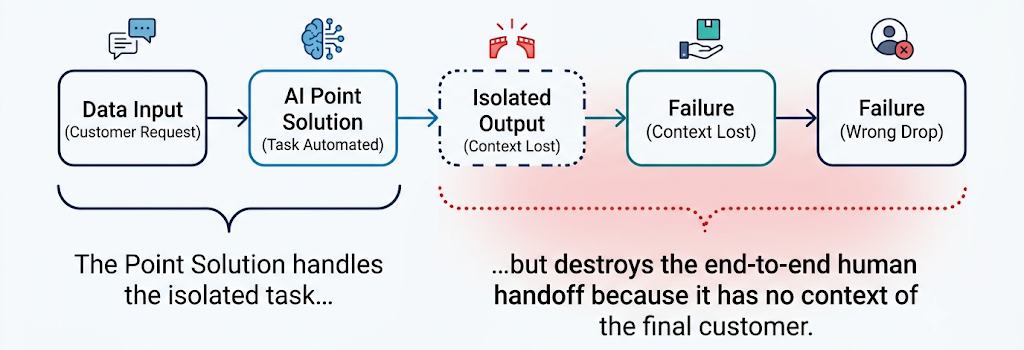
The initial metrics look great, the ML metrics even more impressive. Processing times reduce, throughput rises, or the localized cost-per-transaction drops. The AI point solutions successfully solve their micro-problems.
However, because these point solutions operate in functional silos, they destroy the end-to-end human handoff. The automated system captures the data and executes the task, but strips away the essential context. Alluding to who requested the output, where they sit in the lifecycle, and why specific customizations matter.
As a result, the enterprise engine processes data at lightning speed, but routinely delivers the equivalent of a black coffee to a tea drinker at the final point of delivery.
Why Governance Cannot Fix a Context Gap
When these last-mile breakdowns occur, enterprise leadership often attempts to solve the problem by imposing stricter governance, additional compliance checks, or manual approval gates. That is the fashionable go-to these days.
However, governance cannot solve an architectural context problem.
Adding regulatory checkpoints or administrative oversight to a broken workflow can not restore situational awareness. You cannot govern an algorithm into understanding human context. You can only design the system to preserve it. When organizations attempt to fix bad workflow integration with heavy governance, they simply slow down an already defective handoff.
The Mechanics of Context Retention: What Traditional Systems Get Right
When analyzing why traditional floor operations in high-volume Mumbai establishments execute complex custom orders without error, three core architectural principles emerge that software architects must account for:
1. Spatial Mapping Over Flat Data
Traditional operators do not store orders as flat text lists. What they do is attach data directly to visual and spatial coordinates, thus inking the request to a specific seat position and face. Modern AI point solutions, by contrast, flatten data into generic buckets (e.g., “Table X” or “Ticket #nnnn”), erasing individual seat-level attributes.
2. Active Cognitive Engagement
When a server (at the cafe) punches an order into a PoS terminal, the device acts as an external memory store. The operator’s brain offloads the data, clearing short-term memory before the delivery takes place. When automation removes human engagement without maintaining contextual tags, the final execution becomes a guess.
3. End-to-End Workflow Ownership
In high-performing service environments, the context captured at the beginning of the interaction persists to ensure delivery at the end. When automated workflows break that link between input and output delivery without a unifying context layer, accountability ceases to exist in the workflow.
Building Contextual Architectural Discipline
To prevent AI point solutions from degrading the customer experience, enterprise technology leaders must move past isolated task automation and implement systemic discipline across three core areas:
1. Enforce Contextual Metadata Tagging
High-end global hospitality relies on what is called the Pivot Point System. This is a standard where seats are numbered predictably clockwise relative to a fixed entrance point, thus tagging a guest to a known and identifiable location. In enterprise software architecture, every automated payload must carry equivalent spatial and situational metadata. Data processed by the AI engine must remain tagged with the end-user’s specific role, intent, and historical context throughout the entire pipeline.
2. Design Verification Protocols at the Handoff
If an automated system cannot guarantee 100% contextual accuracy at the destination, the workflow protocol must mandate a human verification step prior to final execution. Technology should prompt human confirmation at the point of delivery rather than autonomously bypassing it.
3. Use AI to Reduce Cognitive Load, Not Human Awareness
Enterprise AI should reduce backend operational friction so that human teams have the cognitive bandwidth to focus on the end customer. If technology is implemented right, it removes administrative burden to enable greater empathy and situational awareness, rather than replacing human attention altogether.
Deploying AI point solutions to solve localized operational bottlenecks yields minimal ROI if the output fails at the point of customer delivery. True AI proliferation requires designing workflows that preserve human context from initial capture to final handoff.
Before integrating the next automated tool into your enterprise pipeline, evaluate the end-to-end architecture: Is the system designed to recognize who is sitting at Seat 1, or is it merely delivering generic outputs to Table X?
3nayan can help you get your organisation ready for AI implementations and proliferations in an integrated fashion. Want to know how? Talk to us.
About The Author
