Enterprise AI Commoditization: The Boardroom Asset Strategy
The Governance Illusion
Building on our recent analysis of how the Intercept Fallacy causes leadership to fixate on milestone dates rather than continuous operational trajectory, a much larger corporate risk looms directly behind it. That of enterprise AI commoditization.
If you were to speak with transformation designers (the real ones) you will hear them referring a certain type of recurring governance contradiction, in board meetings. Directors are often willing to sign off on massive, predictable capital allocations for commoditized technology providers, generic hyperscaler architectures, and traditional software licensing. But they start having kittens, the moment a custom, proprietary data initiative enters its initial deployment phase. The board aggressively cross-examines the investment because surface-level operational metrics temporarily fluctuate.
This behavioral anomaly stems from a profound lack of strategic imagination at the leadership level. Today, executive teams routinely hide behind generic, sanitized data to play it safe. But when every player in an industry uses the exact same external models, the same vendor platforms, and the same cleaned-up inputs, everyone becomes equally dull.
You achieve absolute compliance, but you completely wipe out any chance of differentiation. Once your technology stack looks identical to your competitors’, your strategic levers disappear. You are left with only price reduction and aggressive, defensive cost squeezing.
1. The Bloated Efficiency Mirage
Right now, boards are using the wave of enterprise AI commoditization as a convenient cover story to trim legacy operational bloat. Dropping headcount, under the efficiency banner, satisfies short-term market pressures. But over a slightly longer term, data shows, inserting automated models onto an un-optimized process, yields net-neutral economic returns.
True workforce optimization cannot be achieved by a generic plug-and-play installation. AI can automate isolated tasks, but human intelligence remains mandatory to manage the critical exceptions, the governance, the ethics, and the systemic oversight. AI can only take the enterprise so far. For a technology transformation to permanently compress your cost structure, workforce planning must be engineered completely differently from the beginning. It has to be designed around systemic velocity rather than simple headcount reduction.
2. Vendor Rent Extraction vs. Asset Sovereignty
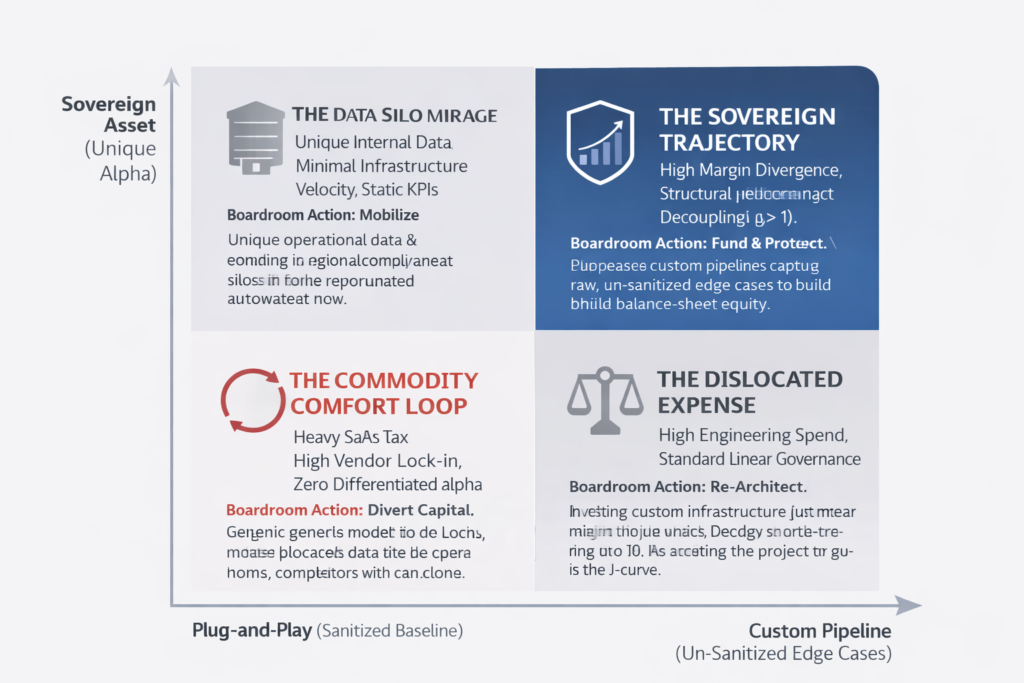
Then, consider how organisations are failing to distinguish between an operational utility and an asset. It is the easiest to seat your workflow on a vendor ecosystem. You pay for seat licenses, their cloud infra, and essentially try to retro-fit your processes to their software. In effect, also funding the vendor’s R&D while your enterprise value remains flat because you have lost data sovereignty, and aren’t using your own data to know, understand and progress. The boards must understand, to escape the AI commoditisation trap, capital must be applied to sovereign data assets.
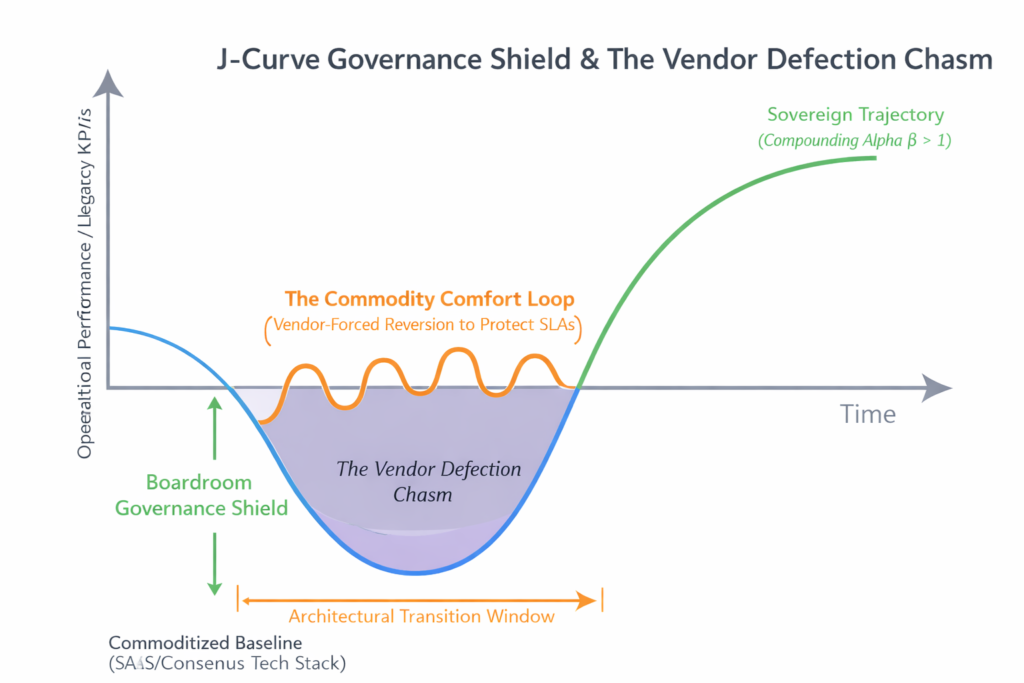
However, transitioning to asset sovereignty requires surviving a predictable operational dislocation, which many organisations are incapable of handling, or at least are loathe to.
3. The Takeaway: A Playbook for Boardroom Defense
Defending this architectural transition requires the Board to play an entirely new governance game. Evaluating a compounding, custom data trajectory using the same traditional linear budgeting rules would just be wrong. Your AI transformation initiative will just be starved of capital before its exponential returns can manifest.
To successfully decouple your enterprise from the commodity loop, leadership must execute a three-part structural shift:
- Isolate the Volatility: Accept the predictable, temporary drop in superficial utilization metrics during the restructuring phase.
- Reallocate Commodity Spend: Incrementally divert capital away from generic software upgrades or outsourced consulting dependencies and funnel those resources directly into proprietary pipeline engineering.
- Implement Expiring Metrics: Build workforce metrics that evaluate how fast human operators and automated systems resolve edge cases together, rather than tracking simple usage.
By moving away from defensive compliance and committing to asset sovereignty, the enterprise stops renting its capabilities from third-party vendors and begins owning its competitive advantage.
About The Author
