The Liability Shield: The Root of Compliant Corporate Failure
In 3nayan‘s previous article, we wrote about how the premature scaling of generic AI models is fueling a global crisis of enterprise AI commoditization. When organizations hasten to automate sanitized, identical data layers, they end up building a “Sameness Engine” of mediocrity that accelerates them toward a zero-margin floor, instead of the intended competitive moat and compliant corporate failure.
But recognizing this trap should trigger a deeper question in the thinking mind – Why? As in, why do exceptionally smart executive teams willfully steer their organizations into a structural loop that actively compresses their own pricing power?
It surely isn’t a lack of technical budget or a missing framework or a tool. The answer is to be found in a deeply ingrained human survival mechanism. Beneath the millions being invested in shiny executive dashboards, a quiet crisis of courage is unfolding, again, across modern enterprises. Instead of being used as an engine to discover breakthrough insights, Data is becoming a corporate insurance policy. More of a Liability Shield explicitly built to protect individuals by shifting accountability onto a compliant process.
1. The Logic Behind “Safe” Disasters and Compliant Corporate Failure
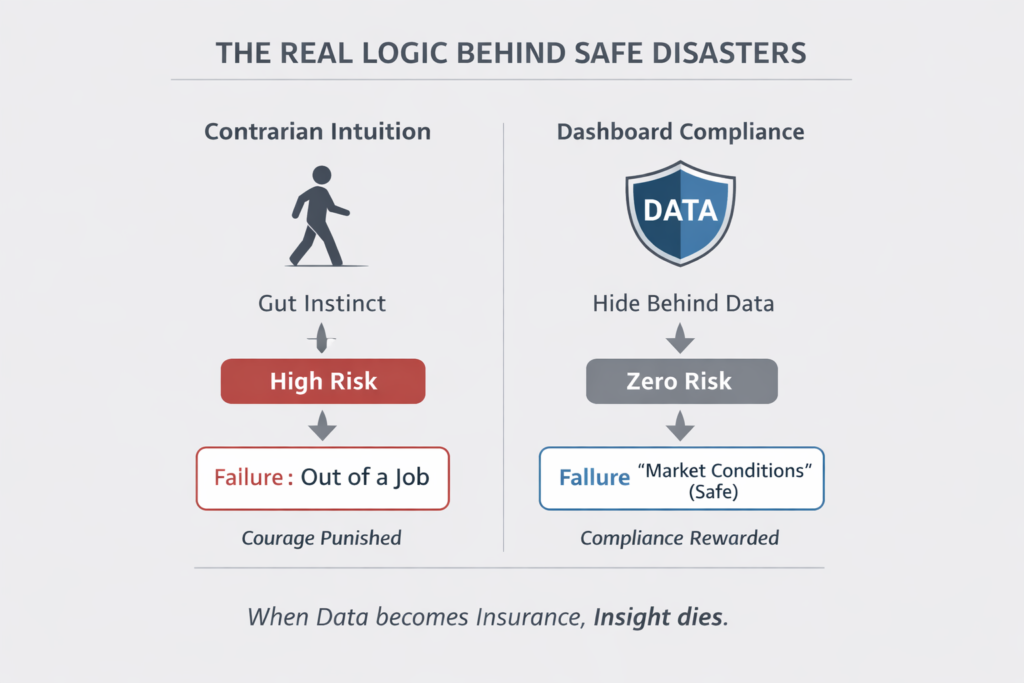
Let us consider the unwritten law of modern corporate survival. There are examples (even in the Indian IT industry) of a leader acting on gut, taking a bold, contrarian bet and they get eased our, fired, or are left with no choice but to resign. Regardless of whether they decision led to a success of failure.
If that same leader were to hide behind data, the blame could easily be shifted towards the market. This is the same reason why the big name traditional consulting firms are hired to say something “independently”, that the incumbent leader didn’t want to say himself / herself. The CEO plays safe.
This duplicitousness causes compliant corporate failure, describing a dangerous comfort zone where all operational indicators show a compliant green while quickly commoditising business value.
When a corporate culture shifts from chasing breakthrough value to minimizing personal vulnerability, actual strategic growth stops.
2. The Ritual of the Dashboard Blanket
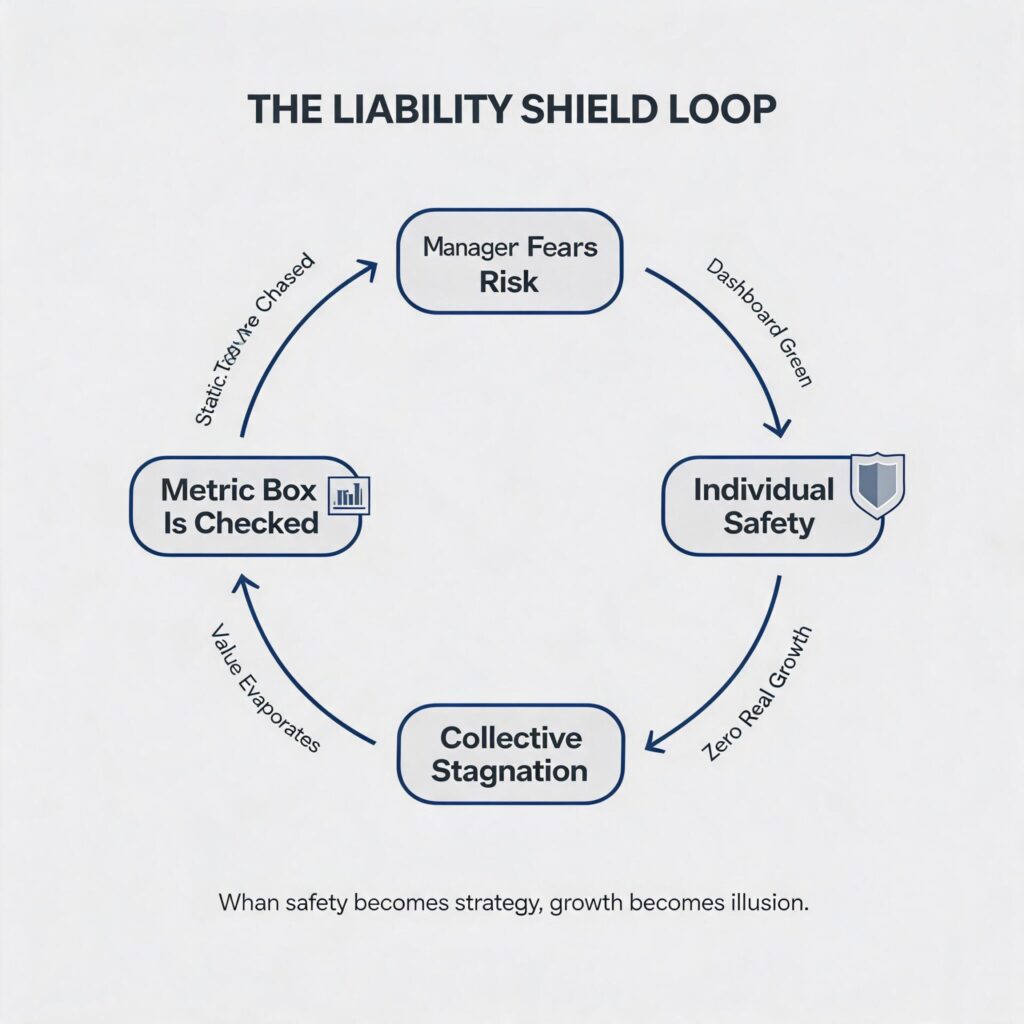
This retreat into standardized numbers is an old human pattern playing out in a modern setting. In her classic work How Institutions Think, anthropologist Mary Douglas pointed out that organizations naturally survive by creating systems that remove individual risk-taking. They build elaborate routines that protect the group by taking away individual responsibility. In today’s enterprise, the real-time data dashboard is the ultimate version of this protective safety blanket.
Add to this, British anthropologist Marilyn Strathern’s brilliant rule: “When a measure becomes a target, it ceases to be a good measure”, and the structural trap of compliant corporate failure becomes entirely transparent:
The metric remains the undeniable evidence of corporate health. The team performs the ritual perfectly by cleaning the data, filling out the rows, and checking the compliance boxes. If the business fails to capture market value, everyone blames external factors, never the metric they were chasing.
3. The Industry Blind Spot: Tracking the Wrong Milestones
Today, the Liability Shield is being deployed with greatest frequency in the frantic rush toward enterprise AI adoption. Whether it is a Global Capability Center looking to justify its footprint, an IT services giant trying to protect its margins, or a tier-one consulting firm like Accenture managing a massive implementation, the structural incentives are completely misaligned.
Consultants and service providers are naturally incentivized to design frameworks that guarantee predictable, defensible outcomes. So what if those outcomes lead straight to total commoditization. They protect the enterprise leadership by tracking static, point-in-time metrics (like “95% SLA adherence,” “100% data governance alignment,” or “number of seats migrated to Copilot”) because those numbers are auditable, clean, and safe.
This hyper-focus on absolute process safety, obviously, creates a terminal blind spot:
| The Corporate Liability Shield | The High-Velocity Trajectory |
| Primary Goal: Auditability & Personal Safety | Primary Goal: Real Value Realization |
| Metric Horizon: Static SLA Compliance (Point-in-Time) | Metric Horizon: Dynamic Process Acceleration (Slope) |
| Leadership Focus: Defending the Status Quo | Leadership Focus: Testing the Frontier |
| Systemic Result: Compliant Corporate Failure | Systemic Result: Compounding Competitive Moats |
The center achieves perfect operational compliance, but because the data has been completely sanitized to keep the shield intact, real corporate imagination atrophies. The enterprise pays the massive overhead, the consultants collect their recurring advisory fees, and the GCC remains a cost-center bottleneck incapable of generating non-linear value.
4. The Antidote: Give Your Metrics an Expiration Date
To stop the slide toward compliant corporate failure, leadership must understand that KPIs must possess a built-in expiration date and thus have to be implemented accordingly. A metric is an operational crutch to stabilize a specific human behavior during a precise window of transition. It can not be a permanent corporate establishment.
Once an operational behavior is locked into the fabric of your corporate culture, the corresponding metric must be retired or evolved. If your teams are tracking the exact same SLA baseline for three consecutive years, there is no agility left.
Shifting Focus to the Slope – stepping away from Compliant Corporate Failure
High-performing companies reject static targets. They force metrics to evolve dynamically across three distinct horizons as their team’s capability matures:
- Step 1: Workflow Asset Turns (The Stabilization Phase): Simply measure if the new machine works. Are people using the AI workflows? Are the new digital assets actually running?
- Step 2: Margin-Volume Divergence (The Economic Phase): Once the behavior is locked in and “turns” stabilize, stop measuring utilization. Move up the slope to measure economic asymmetry. Are you decoupling revenue growth from headcount growth? Say, if volume rises 30% but margins expand instead of tracking linear costs, you have unlocked Step 2.
- Step 3: Workflow Cycle Time Compression (The Velocity Phase): Once the economic engine is proven, scale to the velocity. Now measure the compression of time itself across the entire system to out-pace market shifts.
By forcing the target to constantly move along a upward trajectory, you prevent teams from gaming a static metric, breaking the defensive utility of the dashboard and reorienting the culture around genuine velocity.
5. The Next Step
Check if this sounds familiar – people are spending time, in your leadership meetings, debating the color coding of a single spreadsheet cell, when they should be analysing the compounding slope of your operational trajectory. If so, the company is paying for a rather expensive illusion of control instead of managing risk.
Before approving your next wave of automation capital, please ask yourself a hard question: Are your metrics built to accelerate the actual business, or are they simply designed to protect your leadership team from the consequences of a slow, compliant corporate decline?
In our next post, we will shift from diagnosis to the actual blueprint, breaking down the exact mechanics required to replace static metrics with dynamic vectors: The Intercept Fallacy and the J-Curve Paradox.
About The Author
