Enterprise AI Commoditization: The Trap of Accelerated Sameness
Have you noticed, most enterprises are currently running the exact same playbook, operating under a collective delusion.
They are licensing the same foundational Large Language Models, passing them through similar security sanitization filters, and then pointing them at the same legacy databases to automate the same transactional workflows. Boardrooms are celebrating this as “AI-led digital transformation.” This is a race to a zero-margin floor, in reality.
Intelligence, today, is universally accessible and identically priced. Speed has ceased to be a strategic differentiator. Now, if your your organization is scaling techn on a broken, undifferentiated data foundation, where is the competitive moat? This is funding a Sameness Engine (to coin a phrase), albeit incredibly efficient, and accelerates enterprise AI commoditization by automating your own irrelevance. At speed.
1. The Paradox of Sameness at Speed
As foundational technology gets democratized, the economic asymmetry that creates true pricing power sublimates.
Consider the modern structural trap: If two competing organizations deploy identical, off-the-shelf generative AI models to optimize their engineering output or customer operations, they trigger an immediate, irreversible economic sequence:
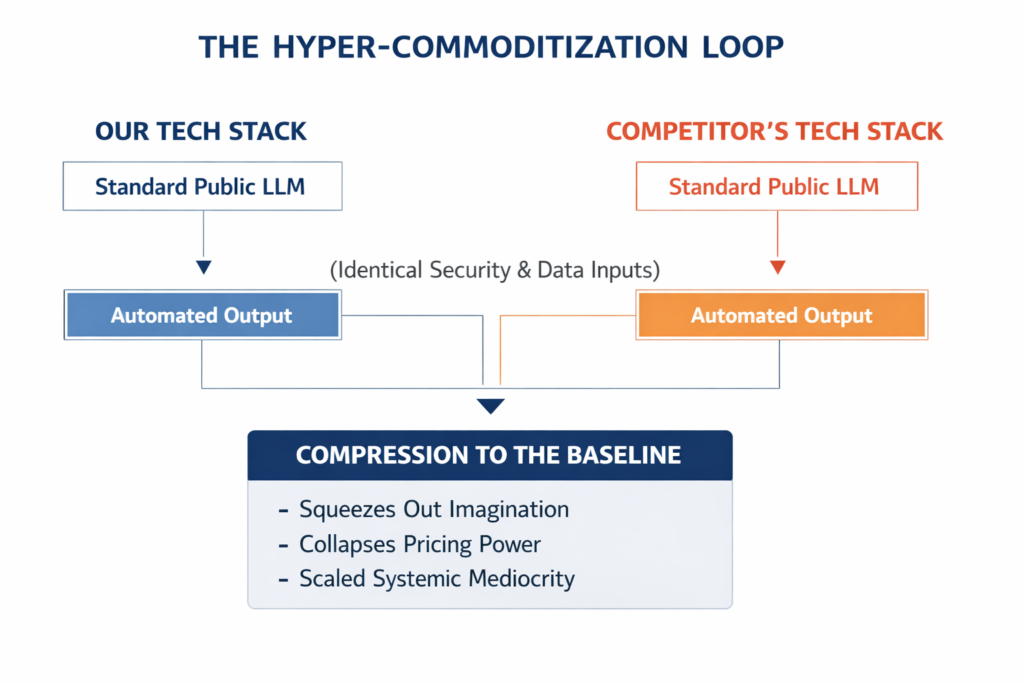
The initial operational cost reduces sharpy, but briefly. However, the resulting output is structurally identical to the market baseline. This causes the pricing power to collapse. The hard-won cost savings are instantly absorbed by the market, leaving the enterprise with squeezed margins, a high fixed-technology bill, and absolutely no strategic differentiation.
2. The Data Fallacy and the Death of Imagination
This systemic drift toward mediocrity is driven by a fundamental misunderstanding, essentially, a Data Fallacy. This is the naive corporate belief that increasing the volume and processing velocity of data automatically yields superior strategic outcomes.
To mitigate security exposures and ensure compliance, corporate risk architectures use data strip it of its variance, its anomalies, and its contextual edges and throw up what is sterile. So, when you feed highly sophisticated, generic models a diet of completely standardized information, you can achieve a highly predictable result: systematically automated average.
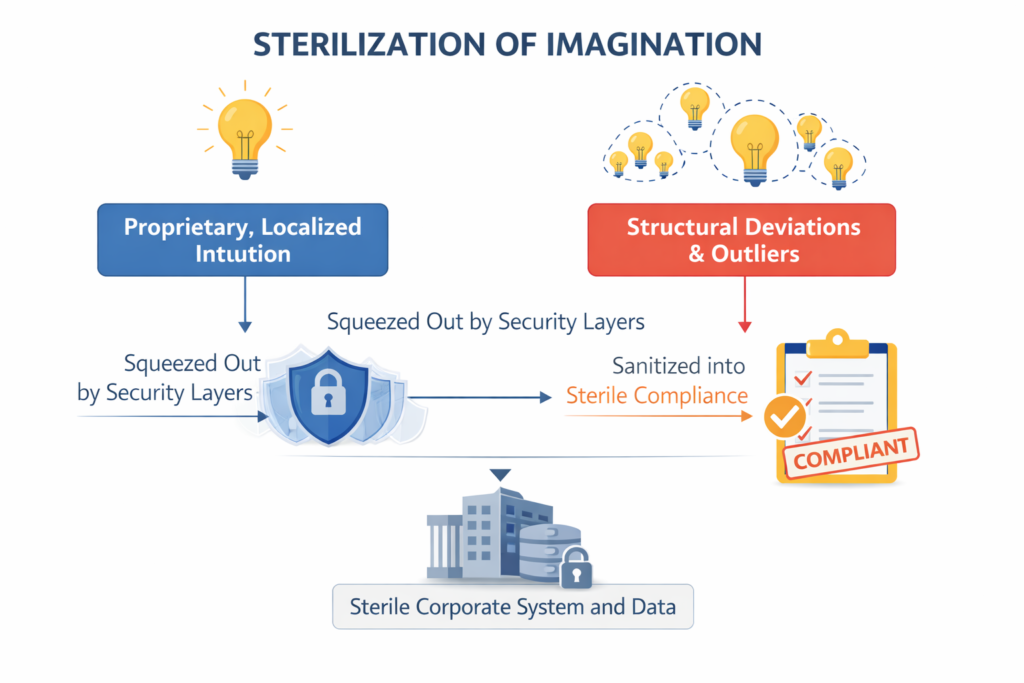
This prioritisation of isolating risk absolutely over localised intuition, organizations are eliminating the human variance. That is real source of non-linear breakthroughs. This standardization drives enterprise AI commoditization.
3. Premature Scaling: The Capital Expenditure Chasm
The industry data reveals the terrifying scale of this disconnect and operational mismatch: while enterprise infrastructure spending on AI is compounding at an aggressive 155% CAGR, a staggering 57% of organizations admit their core data foundations are completely unsuited for advanced AI deployment.
This structural imbalance triggers Premature AI Scaling; essentially an error where organizations scale processing velocity way ahead of data maturity. This can only lead to a systemic capital bleed.
This gap creates a drag on the balance sheets, costing the average enterprise upwards of $12.9 mn p.a. in wasted compute, abandoned PoCs. This leads to highly engineered pipelines that deliver no measurable enterprise outcomes.
4. The GCC and IT Services Arbitrage Collapse
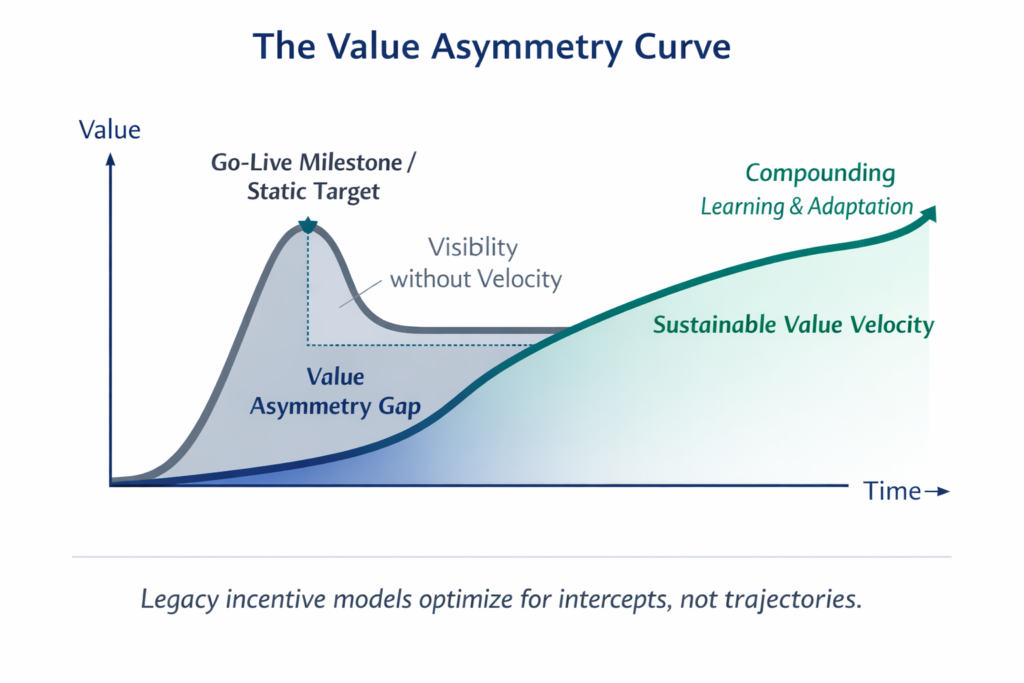
This crisis of enterprise AI commoditization appears to be most acute within Global Capability Centers (GCCs) and legacy IT Services providers. However, no many are referencing it.
These entities were started decades ago, for the predictable yield of labor arbitrage. Today, they are attempting to execute an unhedged transition to “AI arbitrage.” Providers are, however, structurally incentivized to chase point-in-time “go-live” intercepts. Essentially, highly visible milestones that look stellar on a quarterly slide deck but remain strategically silent. We submit that this the provider incentive model is fundamentally broken.
Because these models are bolted onto highly fragmented, legacy data architectures, the long-term trajectory plateaus. If a provider’s primary value proposition is that they can generate code or process customer tickets at a faster rate than before, they are hastening their own obsolescence.
5. The Frontier Imperative
We hope not, but if your current AI roadmap mirrors the consensus architecture of your closest competitor, you are not really transforming your business. The likelihood is it does, and that implies, you are funding accelerating disruption. True enterprise differentiation is born from the unique, systemic way your organization captures, structures, and exploits its proprietary data pipeline. It does not reside in the model you license.
Before you invest another dollar into accelerating your operational velocity, you must determine whether your architecture is built to cultivate asymmetric advantage, or if it is merely an expensive shield designed to help you fail compliantly alongside your peers. You many also choose to do a quick assessment to show your state of readiness at a high level.
In our next post, we will unmask the organizational defence mechanisms and tribal anthropology that compel otherwise brilliant leaders to buy into this commoditization loop: The Liability Shield.
About The Author
