Enterprise AI Management: From Strategy to Measurable Impact
Enterprise AI management requires more than selecting promising use cases and deploying capable models. Organisations must make connected decisions about business priorities, process design, technology architecture, cost, governance, workforce capability and performance measurement. When teams manage these decisions separately, progress in one area may not translate into enterprise impact. The challenge is to coordinate them, sequence the necessary interventions and establish how results will be measured. Enterprise AI management provides a way to bring these decisions into one connected programme.
1. The enterprise AI challenge has several dimensions
The practical challenges of enterprise AI extend across the organisation.
- Economics. The cost of an AI solution depends on more than model or token prices. Execution may involve retrieving information, establishing context, selecting tools, coordinating agents, validating outputs and retrying failed tasks. These activities affect the cost of completing a business task and the economics of scaling it.
- Technology architecture. AI systems must operate within real enterprise environments. They need reliable access to relevant information, continuity across tasks, coordination between components and mechanisms to handle failures. Architecture decisions influence both operational reliability and the effort required to maintain a solution.
- Business execution. An AI system must fit the process in which it operates. A useful prediction or recommendation creates limited value if the organisation cannot act on it, if exceptions fall outside the intended workflow, or if the system’s decisions do not reflect business priorities.
- Governance and control. As AI systems take on more complex tasks, organisations need clear boundaries for autonomous action, appropriate human oversight, accountable ownership and processes for managing exceptions. These controls must support execution rather than exist only as policy documents.
- Organisational capability. Employees need the skills and process knowledge to work with AI, evaluate its outputs and improve the way work gets done. Leaders must also establish ownership for outcomes and create a repeatable approach to learning from deployment.
These dimensions interact. A technically sound solution can struggle within an inconsistent workflow. A promising use case can become uneconomic when it requires extensive exception handling. A successful pilot may fail to scale when ownership, controls or workforce capability remain unresolved.
The management task is to understand these dependencies before committing to scale, then address them in a deliberate sequence.
2. Why organisations need an integrated approach
Each dimension raises a different management question. Leaders need to know whether the organisation is ready, which interventions should happen next, whether the investment is producing results, and whether the capabilities required for sustained performance are improving.
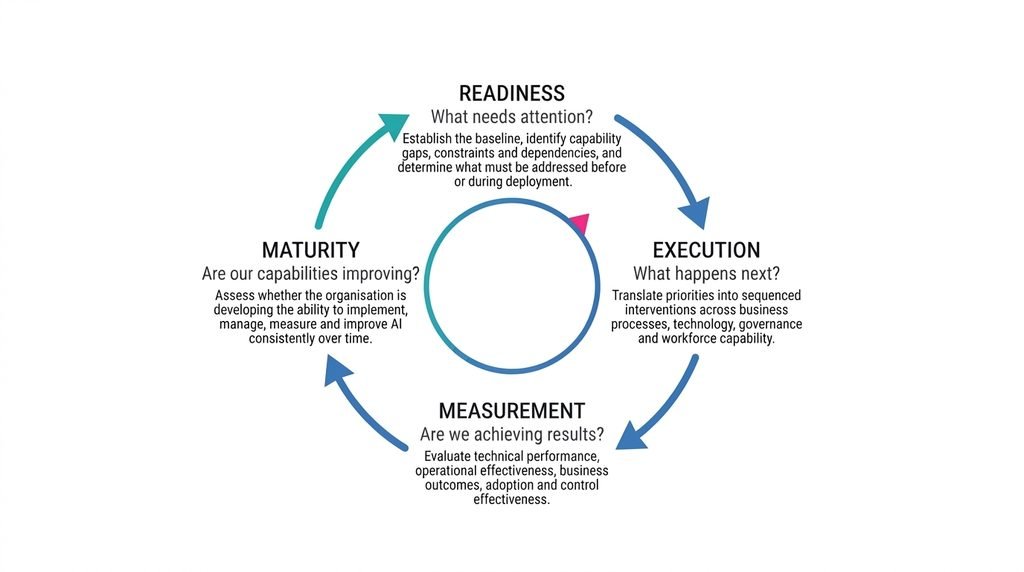
- Readiness: What needs attention?
- Execution: What happens next?
- Measurement: Are we achieving results?
- Maturity: Are our capabilities improving?
These questions cannot be answered independently. Readiness findings should shape implementation priorities. The roadmap should establish the interventions, ownership and expected outcomes. Measurement should reveal whether those interventions are working. Maturity assessment should help determine which capabilities need further development.
This connection is important because AI deployment is rarely a single technical event. It is a continuing programme of business and organisational change. An integrated approach gives leaders a way to manage that programme as a whole.
3. How AIM connects the four elements
The AIM Framework, developed by 3nayan, connects four elements of enterprise AI management: Readiness Assessment, Integrated Implementation Roadmap, KPI Framework and Maturity Model. Each addresses a distinct management need, while the four operate as a connected system.
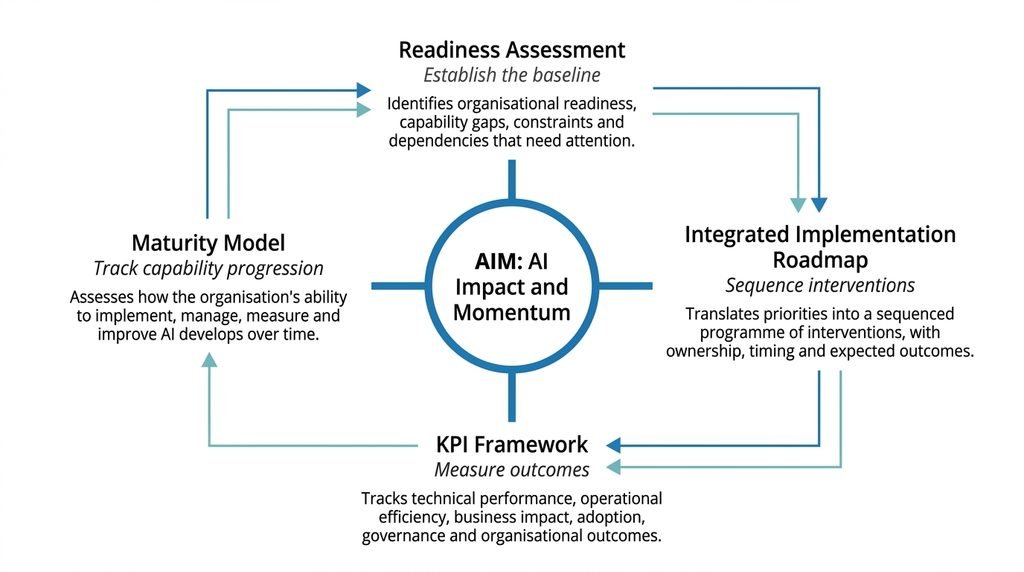
- Readiness Assessment: Establish the baseline and identify gaps, constraints and dependencies.
- Integrated Implementation Roadmap: Translate priorities into sequenced interventions, with ownership, timing and expected outcomes.
- KPI Framework: Track technical performance, operational efficiency, business impact, adoption, governance and organisational outcomes.
- Maturity Model: Assess progression in the organisation’s ability to implement, manage, measure and improve AI.
The value lies in the connection between the elements. A readiness assessment without a roadmap may identify problems without establishing what to do about them. A roadmap without suitable KPIs may track activity without demonstrating impact. KPIs without a maturity perspective may reveal poor performance without showing which underlying capabilities need to improve.
AIM brings these activities into a common management approach. It helps organisations connect what they need to address, what they will do, what they expect to achieve and how they will assess progress.
4. Applying AIM: An AI-enabled customer service operation
Consider an organisation deploying AI agents to handle customer requests, resolve routine issues and escalate complex cases. Initial tests may be promising, yet live performance could fall short because policies vary across departments, workflows are poorly integrated, employees do not trust the system, or complex cases require more effort than expected.
AIM would help structure the response across four elements:
- Readiness Assessment: Examine process consistency, system integration, workforce capability, governance, information availability and the organisation’s ability to manage exceptions.
- Integrated Implementation Roadmap: Sequence workflow redesign, technical integration, employee enablement, control mechanisms and a staged rollout.
- KPI Framework: Track resolution time, first-contact resolution, escalation rates, customer outcomes, cost per resolution and employee adoption. Use these measures together to understand performance rather than relying on a single headline metric.
- Maturity Model: Assess whether the organisation can evaluate AI-enabled service consistently, manage exceptions, learn from performance and improve the operation over time.
This approach makes the deployment a business improvement programme, rather than a technology rollout alone. It also creates a basis for deciding whether to expand, redesign or constrain the solution as evidence accumulates.
5. What enterprise leaders should take away
Enterprise AI management starts by connecting decisions that are often distributed across business, technology, risk and people functions.
Leaders should establish a clear baseline before scaling, identify dependencies between technical and organisational interventions, sequence work according to business priorities, and assign ownership for expected outcomes. They should measure technical performance alongside operational results, business impact, adoption and control effectiveness.
They should also revisit these decisions as deployment generates new evidence. Costs, workflows, risks and capability requirements can change as AI systems move from controlled pilots into live operations.
AIM provides a structured way to connect readiness, implementation, measurement and maturity. Its purpose is to help organisations manage AI as a continuing enterprise capability, with a clearer line between investment, action and business outcomes.
About The Author
