Beyond Static ROI: Measuring the AI Investment Trajectory
The primary reason boards terminate AI initiatives prematurely is a fundamental misunderstanding of how value accumulates. Traditional financial models are built to measure “intercepts”—static points in time that show immediate cost savings or productivity gains. However, AI does not behave like a traditional software purchase. Success is determined by the AI investment trajectory, or the “slope” of improvement, rather than the initial performance spike. When leadership relies on lagging indicators, they often mistake the necessary foundational “J-curve” for a lack of progress.
The Mirage of the Pilot Spike
In the early stages of deployment, many organizations experience a “pilot spike.” This is a localized burst of efficiency achieved under controlled, high-touch conditions. Large consulting firms often present these spikes as proof of immediate ROI to encourage rapid, enterprise-wide scaling. This is a strategic error. A spike is often a “bolt-on” victory that lacks the structural integrity to scale. Without measuring the underlying AI investment trajectory, firms find that once the pilot’s specialized support is removed, performance reverts to the baseline, leaving behind significant technical and organizational debt.
Three Gradients for Measuring Success
To move beyond misleading point-in-time metrics, organizations should adopt gradient-based measures. These indicators reveal whether a program is institutionalizing or stalling.
- Workflow Asset Turns: This tracks the task automation rate multiplied by the quality score over time. It measures whether the AI is becoming more reliable as it processes more data, rather than just doing more of the same work poorly.
- Margin-Volume Divergence: This metric tracks the AI-augmented output value per full-time equivalent (FTE) against a historical baseline. It identifies where the organization is successfully decoupling growth from headcount.
- Workflow Cycle Time Compression: This acts as a proxy for working capital efficiency. It tracks the reduction in elapsed time between initial input and final output, showing how effectively AI is removing operational friction.
The Boardroom Review Window
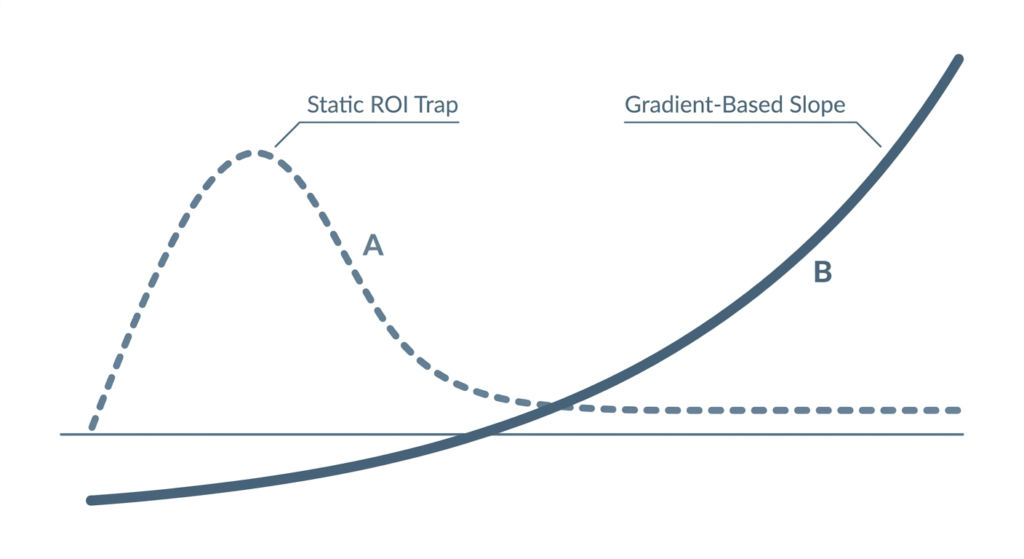
The most critical period for any AI program is the nine-month window following the pilot. During this phase, traditional ROI often looks negative because the organization is investing in the “unsexy” work of data cleaning and process redesign. This is where the AI investment trajectory is actually built. Boards that understand this focus on “velocity of learning” and “gradient improvement” rather than quarterly savings.
Organizations that prioritize building a sustainable slope over chasing an immediate spike eventually reach an inflection point. At this stage, the foundational work allows for exponential scaling. By shifting the focus to the AI investment trajectory, leadership ensures they are funding a durable capability rather than a series of disconnected, non-scalable experiments.

Do a quick 30 question readiness assessment of your organisation here, covering organisational readiness, implementation mechanisms, measurement and also organisational maturity.
About The Author
