The Cosmetic Trap: Why Organizational Change Management Fails
The modern C-suite has a multi-billion-dollar paradox it studiously avoids talking about. Organizations are spending staggering amounts on organizational change management; given the AI based FOMO, yet 70% of transformations continue to end in disaster (says BCG) and not achieve their strategic goals. We deploy armies of consultants and amazing communication plans, operating under the assumption that deep structural anxiety can be solved with a slide deck and a mandatory town hall. Guess what? It can’t.
The execution appears flawless on paper. The standard email newsletters launch timely, town halls fill calendars, training trackers report near-perfect completion metrics too. Then, why does research from the Harvard Business Review, McKinsey, and BCG reveal a different reality?
The failure persists because modern change frameworks have a foundational definition problem. Practitioners consistently mistake the packaging viz. communication plans, slide decks, and training models etc. for the actual product which, 3nayan believes, should be true strategic and psychological alignment.
To break this cycle, organizations must dismantle transactional project-tracking, understand and embrace the behavioral realities of human networks.
The Myth of the Human Reboot
Traditional organizational change management methodologies treat employees like enterprise software systems. They lean heavily on linear logic gates, e.g. build awareness, seed desire, transfer knowledge, validate ability, and anchor reinforcement.
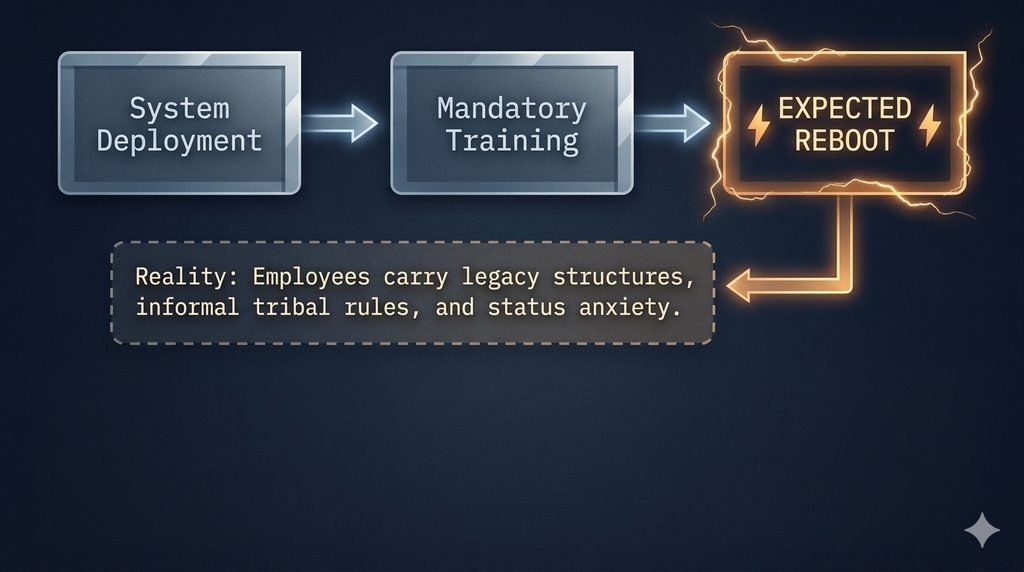
This exemplifies a complete failure in understanding human behaviour in the corporate world. The assumption that human behavior changes like a system upgrade is false. This assumption leads to the management broadcasting a directive, HR or HCM consultants routing staff through a mandatory webinar, and expecting productivity to resume cleanly under new rules.
Human beings do not reboot, not like that, at least.
When a corporate network experiences disruption, individuals carry legacy operating procedures, established (tribal) hierarchies, and structural anxieties. Mechanistic change frameworks function as project management utilities rather than human sciences. They exist to check boxes for a PMO tracker, not to navigate the complex social architecture of an active workforce.
The AI Illusion: It Was Never About the Technology
This administrative bias dominates modern discussions around automated workflows.
Strictly speaking, an independent “AI Transformation” does not exist. The current wave is simply the newest iteration of digital transformation, this time accelerated by artificial intelligence. The baseline challenge remains completely unchanged.
A successful pivot is never determined by software suites, cloud configurations, or updated process maps. Every organizational shift is fundamentally a human transition.
When an enterprise introduces AI-driven tools, deploying the code is the simplest variable. The friction occurs within the employee ecosystem. Advanced automation forces a direct renegotiation of professional identity, authority, and institutional value. If an engineer’s status is tied to writing boilerplate code, or a marketer’s equity is tied to manual copywriting, an automated tool disrupts their sense of worth.
Addressing this core shifts the paradigm from technology implementation to human capability management. One-hour training modules cannot fix shifts in human identity.
The Strategic Translation Gap
For an initiative to succeed, leaders must bridge the chasm between high-level strategy and individual daily execution. This is where transactional methodologies fail.
When a leadership team announces a strategic pivot—such as leveraging data tools for decentralization—planners focus heavily on explaining what the company gains. They broadcast macroeconomic values: market share, agility, and efficiency.
However, an individual contributor five levels down the reporting hierarchy rarely prioritizes quarterly EBITDA. They require a concrete answer to one practical question: “What am I supposed to do differently tomorrow morning, and what behaviors carry social currency now?”
Consider the broken link in a typical rollout:
- Corporate Strategy: “We must use automated insights to take autonomous risks and experiment rapidly.”
- Transactional Management: Send an internal newsletter detailing an “AI Prompt Toolkit” and measure email open rates.
- Employee Reality: “My manager still penalizes me if a project timeline slips. If I experiment and fail, my performance rating drops. I will nod during the town hall, complete the HR tracking module, and keep working exactly as I did before.”
True change strategy requires translating broad goals into localized behavioral micro-contracts. If the strategy shifts, the operational definition of a successful workday must change explicitly for each node in the network. If reporting lines, incentives, and managerial metrics remain static, the transformation remains corporate fiction.
Navigating Liminality: The Geometry of Corporate Limbo
Dismantling an old operating model does not yield an instant transition to a new state. It forces an enterprise into liminality—a term anthropologists like Victor Turner used to describe the volatile, anxious “in-between” phase of a transition.
In this liminal zone, the legacy world is dead, but the new structure is neither fully stable nor trusted.
From a behavioral perspective, organizational culture is a collection of conditioned responses to specific workplace stimuli. Over time, employees learn how to navigate these cues to maintain psychological safety and status:
- The Legacy Loop: Stimulus: A complex problem occurs. → Response: Route it up the ladder for executive sign-off. → Reward: Protection from blame and clear safety.
- The Disrupted Loop: Stimulus: A complex problem occurs. → Response: Leverage automated data tools to make an autonomous decision. → Reward: Unknown, unverified, and perceived as highly risky.
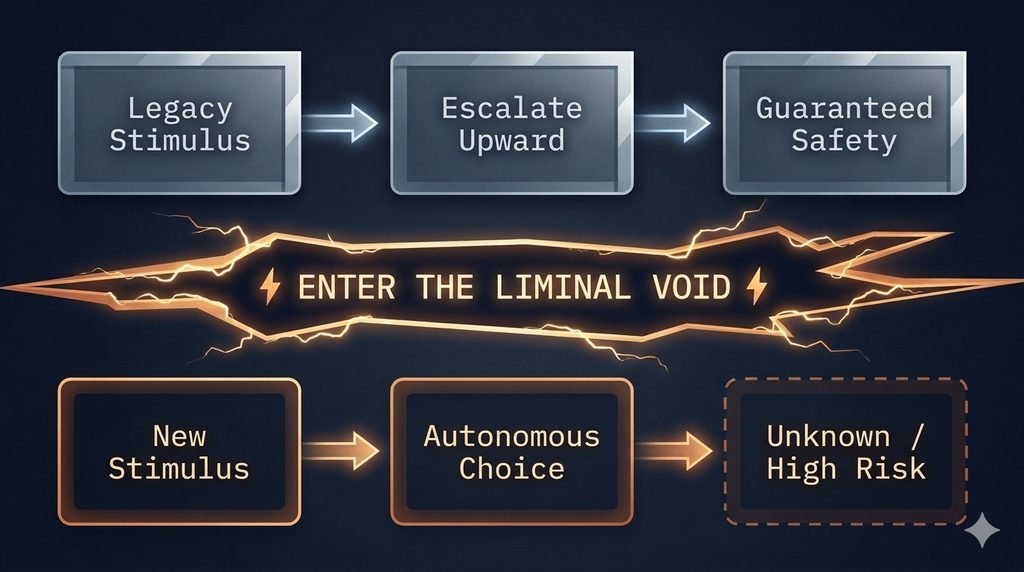
Asking a global workforce to alter these habit loops simultaneously demands massive cognitive energy. Employees rarely resist adjustments out of simple stubbornness. They stall because the cognitive load of limbo forces them to calculate how to alter their response patterns without losing status or safety.
Transactional frameworks often treat this critical phase as an empty block on a timeline—an operational gap to fill with frequent broad communication and forced optimism. They over-index on raw skills training while under-indexing on the natural anxiety of status loss.
When management ignores this friction, teams protect themselves by building underground resistance groups (communitas) to navigate the stress. They satisfy HR’s administrative requirements while quietly maintaining old operational habits.
Moving from Transactional to Structural OCM
To protect transformation investments, enterprise leaders must transition away from superficial task lists and build Structural Change Management.
| Transactional Alignment (Cosmetic) | Structural Alignment (Strategic) |
|---|---|
| Focuses on tracking adoption metrics (log-ins, views). | Focuses on measuring permanent behavioral shifts. |
| Uses mass communication to control noise. | Aligns governance structures and performance incentives. |
| Analyzes individual employees in a vacuum. | Redesigns the broader social and operational system. |
| Logs raw training hours completed. | Identifies and reduces liminal friction across teams. |
Structural change leaders treat communication and training as basic infrastructure rather than the core objective. The critical work requires focusing on three pillars:
- Governance Redesign: Aligning power dynamics, promotional tracks, and compensation models so that adopting new behaviors delivers genuine institutional rewards.
- Behavioral Micro-Contracts: Partnering directly with mid-level managers to translate high-level strategies into clear, daily operational expectations for their immediate teams.
- Liminal Transition Management: Acknowledging the friction of the transition period. Instead of relying on one-way broadcasts, leaders must establish active feedback loops that mitigate identity loss, build psychological safety, and manage behavioral re-conditioning.
Until enterprise systems treat transformation as a problem of behavioral anthropology rather than software installation, change initiatives will struggle. True progress requires shifting attention away from technology updates and focusing directly on the alignment of the human network.
About The Author
